 Add to Chrome
 Add to Firefox
 Add to Edge
Take It or Leave It: Intent-Controlled Partial Optimal Transport
May 19, 2026
While optimal transport (OT) enforces a rigid constraint by requiring two measures to be matched exactly, partial optimal transport relaxes this requirement by allowing mass to remain unmatched through a global budget, scalar rebate, or uniform rejection rule. However, many applications call for more structured, pointwise rejection mechanisms, where the decision to leave mass unmatched depends on side-specific reliability, support geometry, or external information about which components should participate in the comparison. We introduce \emph{intent-controlled partial optimal transport} (IC-POT), a targeted generalization of partial transport that replaces the global rejection paradigm with pointwise rejection costs over both measures. We show that the resulting optimization problem admits a dual interpretation in terms of local acceptance thresholds and can be solved by recasting it as a balanced Kantorovich OT problem on an augmented support. Beyond theoretical analysis, we demonstrate the practical relevance of IC-POT in settings where rejection is driven by side information. In positive-unlabeled learning and open-partial domain adaptation, incorporating pointwise rejection rules that encode statistical structure improves fixed baseline pipelines. Finally, we motivate the use of IC-POT with a geophysical practical case: multi-modal satellite ocean measurements, for which physical and sensors priors naturally inform the rejection mechanism and define the retrieved comparable signal information.

Spherical Harmonic Optimal Transport: Application to Climate Models Comparisons
May 19, 2026Optimal transport provides a powerful framework for comparing measures while respecting the geometry of their support, but comes with an expensive computational cost, hindering its potential application to real world use cases. On manifolds, convolutional algorithms based on the heat kernel have been proposed to alleviate this cost, but their theoretical properties remain largely unexplored. We establish that the heat kernel cost converges to the optimal transport cost as time vanishes in the balanced and unbalanced cases. In the specific case of the 2-sphere $\mathbb{S}^2$, we ensure that the associated Sinkhorn divergences retains the desirable geometric and analytic properties of classical optimal transport discrepancies. Moreover, we leverage the harmonic structure of the sphere to derive a fast Sinkhorn algorithm, requiring only $\mathcal{O}(n)$ memory and $\mathcal{O}(n^{3/2})$ time per iteration, with fully dense GPU-friendly operations. We validate its computational efficiency on synthetic data, and discuss its potential use in the evaluation of global climate models, providing both spatial and seasonal insights into models performances.
Busemann Functions in the Wasserstein Space: Existence, Closed-Forms, and Applications to Slicing
Oct 06, 2025The Busemann function has recently found much interest in a variety of geometric machine learning problems, as it naturally defines projections onto geodesic rays of Riemannian manifolds and generalizes the notion of hyperplanes. As several sources of data can be conveniently modeled as probability distributions, it is natural to study this function in the Wasserstein space, which carries a rich formal Riemannian structure induced by Optimal Transport metrics. In this work, we investigate the existence and computation of Busemann functions in Wasserstein space, which admits geodesic rays. We establish closed-form expressions in two important cases: one-dimensional distributions and Gaussian measures. These results enable explicit projection schemes for probability distributions on $\mathbb{R}$, which in turn allow us to define novel Sliced-Wasserstein distances over Gaussian mixtures and labeled datasets. We demonstrate the efficiency of those original schemes on synthetic datasets as well as transfer learning problems.
Bridging Arbitrary and Tree Metrics via Differentiable Gromov Hyperbolicity
May 28, 2025Trees and the associated shortest-path tree metrics provide a powerful framework for representing hierarchical and combinatorial structures in data. Given an arbitrary metric space, its deviation from a tree metric can be quantified by Gromov's $\delta$-hyperbolicity. Nonetheless, designing algorithms that bridge an arbitrary metric to its closest tree metric is still a vivid subject of interest, as most common approaches are either heuristical and lack guarantees, or perform moderately well. In this work, we introduce a novel differentiable optimization framework, coined DeltaZero, that solves this problem. Our method leverages a smooth surrogate for Gromov's $\delta$-hyperbolicity which enables a gradient-based optimization, with a tractable complexity. The corresponding optimization procedure is derived from a problem with better worst case guarantees than existing bounds, and is justified statistically. Experiments on synthetic and real-world datasets demonstrate that our method consistently achieves state-of-the-art distortion.
Train Till You Drop: Towards Stable and Robust Source-free Unsupervised 3D Domain Adaptation
Sep 06, 2024We tackle the challenging problem of source-free unsupervised domain adaptation (SFUDA) for 3D semantic segmentation. It amounts to performing domain adaptation on an unlabeled target domain without any access to source data; the available information is a model trained to achieve good performance on the source domain. A common issue with existing SFUDA approaches is that performance degrades after some training time, which is a by product of an under-constrained and ill-posed problem. We discuss two strategies to alleviate this issue. First, we propose a sensible way to regularize the learning problem. Second, we introduce a novel criterion based on agreement with a reference model. It is used (1) to stop the training when appropriate and (2) as validator to select hyperparameters without any knowledge on the target domain. Our contributions are easy to implement and readily amenable for all SFUDA methods, ensuring stable improvements over all baselines. We validate our findings on various 3D lidar settings, achieving state-of-the-art performance. The project repository (with code) is: github.com/valeoai/TTYD.
Sliced-Wasserstein Distances and Flows on Cartan-Hadamard Manifolds
Mar 11, 2024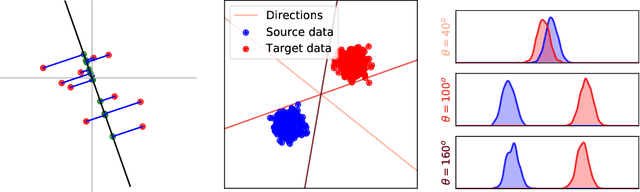



While many Machine Learning methods were developed or transposed on Riemannian manifolds to tackle data with known non Euclidean geometry, Optimal Transport (OT) methods on such spaces have not received much attention. The main OT tool on these spaces is the Wasserstein distance which suffers from a heavy computational burden. On Euclidean spaces, a popular alternative is the Sliced-Wasserstein distance, which leverages a closed-form solution of the Wasserstein distance in one dimension, but which is not readily available on manifolds. In this work, we derive general constructions of Sliced-Wasserstein distances on Cartan-Hadamard manifolds, Riemannian manifolds with non-positive curvature, which include among others Hyperbolic spaces or the space of Symmetric Positive Definite matrices. Then, we propose different applications. Additionally, we derive non-parametric schemes to minimize these new distances by approximating their Wasserstein gradient flows.
Distributional Reduction: Unifying Dimensionality Reduction and Clustering with Gromov-Wasserstein Projection
Feb 03, 2024Unsupervised learning aims to capture the underlying structure of potentially large and high-dimensional datasets. Traditionally, this involves using dimensionality reduction methods to project data onto interpretable spaces or organizing points into meaningful clusters. In practice, these methods are used sequentially, without guaranteeing that the clustering aligns well with the conducted dimensionality reduction. In this work, we offer a fresh perspective: that of distributions. Leveraging tools from optimal transport, particularly the Gromov-Wasserstein distance, we unify clustering and dimensionality reduction into a single framework called distributional reduction. This allows us to jointly address clustering and dimensionality reduction with a single optimization problem. Through comprehensive experiments, we highlight the versatility and interpretability of our method and show that it outperforms existing approaches across a variety of image and genomics datasets.
Interpolating between Clustering and Dimensionality Reduction with Gromov-Wasserstein
Oct 05, 2023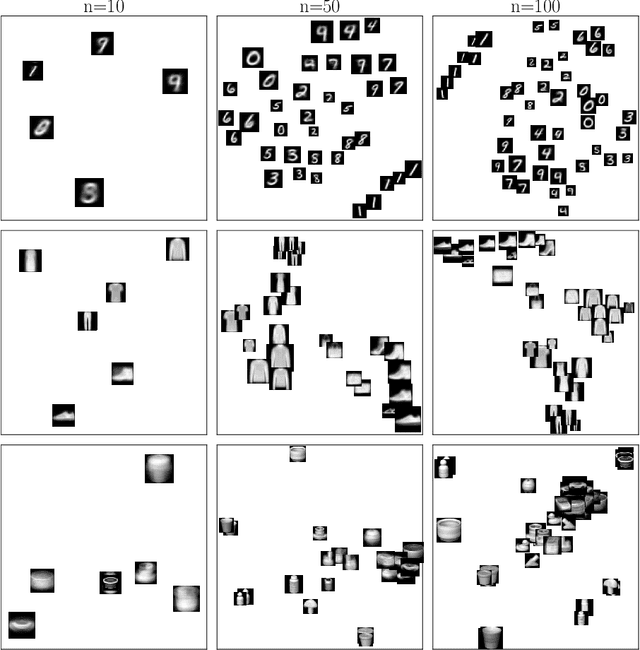

We present a versatile adaptation of existing dimensionality reduction (DR) objectives, enabling the simultaneous reduction of both sample and feature sizes. Correspondances between input and embedding samples are computed through a semi-relaxed Gromov-Wasserstein optimal transport (OT) problem. When the embedding sample size matches that of the input, our model recovers classical popular DR models. When the embedding's dimensionality is unconstrained, we show that the OT plan delivers a competitive hard clustering. We emphasize the importance of intermediate stages that blend DR and clustering for summarizing real data and apply our method to visualize datasets of images.
Optimal Transport with Adaptive Regularisation
Oct 04, 2023Regularising the primal formulation of optimal transport (OT) with a strictly convex term leads to enhanced numerical complexity and a denser transport plan. Many formulations impose a global constraint on the transport plan, for instance by relying on entropic regularisation. As it is more expensive to diffuse mass for outlier points compared to central ones, this typically results in a significant imbalance in the way mass is spread across the points. This can be detrimental for some applications where a minimum of smoothing is required per point. To remedy this, we introduce OT with Adaptive RegularIsation (OTARI), a new formulation of OT that imposes constraints on the mass going in or/and out of each point. We then showcase the benefits of this approach for domain adaptation.
Match-And-Deform: Time Series Domain Adaptation through Optimal Transport and Temporal Alignment
Aug 25, 2023


While large volumes of unlabeled data are usually available, associated labels are often scarce. The unsupervised domain adaptation problem aims at exploiting labels from a source domain to classify data from a related, yet different, target domain. When time series are at stake, new difficulties arise as temporal shifts may appear in addition to the standard feature distribution shift. In this paper, we introduce the Match-And-Deform (MAD) approach that aims at finding correspondences between the source and target time series while allowing temporal distortions. The associated optimization problem simultaneously aligns the series thanks to an optimal transport loss and the time stamps through dynamic time warping. When embedded into a deep neural network, MAD helps learning new representations of time series that both align the domains and maximize the discriminative power of the network. Empirical studies on benchmark datasets and remote sensing data demonstrate that MAD makes meaningful sample-to-sample pairing and time shift estimation, reaching similar or better classification performance than state-of-the-art deep time series domain adaptation strategies.